Both of us have always said that one of our most favourite parts of creating cnscs_ is the interviews we get to do. Each person shows up in the world in such a unique way and has such a different focus, but each time we end the interview, our hearts are full from having learnt so much and knowing that we get to share those wisdoms with all of you. Today, we are feeling so filled with joy and excitement to share an interview with another one of our all-time faves, with you – Chandra Mophethe.
If you don’t already follow Chandra on Instagram, you are missing out. Chandra strongly believes that the African fashion industry is at the heart of the future of fashion, because so many African fashion designers already practice sustainability in their design processes (and, we couldn’t agree more). She practices what she preaches too, by encouraging us to redefine our ideas of luxury by centring African design and constantly sharing different local brands that we can invest in, using her #shopmadeinafrica. Needless to say, we have learnt so much from Chandra and feel so lucky to call her a friend!
After admiring her for so long, we thought it was about time to ask Chandra a few questions about her journey with slow fashion, her advocacy for all things local, and her thoughts on the future of Africa fashion.
Masego and Stella: Can you tell us about what your day job entails and how it’s linked to your interest in fashion?
Chandra: Actually, what I am doing now doesn’t relate to fashion, but the end goal is to work in fashion – more on the e-commerce side. I am currently working for the UCT Careers Service. I do their social media and look after their website, which is very similar to what I did when I was working at Merchants on Long.
When I graduated from my undergraduate, I wanted to be a journalist. Then, I noticed that Merchants on Long was advertising an internship, and there weren’t any internships for magazines at the time. So, I thought I’d apply and give it a try. That became my gateway for discovering what made-in-Africa fashion is. My internship required me to manage their blog and social media, which grew into me doing the website and social media, full time.
Ultimately, I would like to be working with social media and websites, but with a focus on fashion. I really enjoy e-commerce, so I spend a lot of time on websites just looking at how they are designed and how the user experience works. I am always thinking about how people experience a website. Working for Net-a-Porter would be my ultimate goal. I’m not as interested in being involved in the front end of fashion, but I’m interested in everything that happens behind the scenes. That is what excites me.
M & S: On your blog and your Instagram, you are constantly sharing African fashion brands and encouraging people to support local, using the #shopmadeinafrica. When did your fascination with African fashion begin, and why did you make it your mission to begin sharing and advocating for African fashion?
C: It started at Merchants on Long. I remember walking into the store on my first day and thinking, “what is this place?” I had a very Western view of what African fashion was – you know, the wax prints, kente cloth, and the Maasai tribal prints. In my mind, that’s all that African fashion was. Being at Merchants, I was introduced to so many African designers (like Sindiso Khumalo and Maxhosa) and my mind started realising that there was another dimension to African fashion. I was really intrigued and also shocked at the fact that I live in Africa and I didn’t know about this fashion.
I was working on their blog, which meant always looking for new things to write about and interviewing the designers that we stocked. Talking to the designers got me super invested in this idea of African fashion. That’s when I started thinking that I couldn’t be the only one who wasn’t aware of this dimension of African fashion. So, I thought, “let me save someone the embarrassment that I had to go through by sharing what African fashion really is.” That’s when I started talking about it.
S: I am so glad you did that, because I have learnt so much, through you.
C: Thank you! And then also, the year after I started working at Merchants was the first Fashion Revolution event in South Africa. Lalesso had invited us to the Fashion Revolution event. That is where I saw the trailer for The True Cost and I was like, “wait a minute!” *laughs* Then, I decided to start sharing more local designers, because of how shocked I was by the state of the fashion industry. After watching The True Cost, I was in denial for the rest of the year!
S: Wow! So, your journey with sustainable fashion began at the same time as Fashion Revolution began in South Africa.
C: Yeah, and I was definitely in denial for most of the time.
S: I did not know about them for a while after that. I’m curious to know how you think Fashion Revolution South Africa has changed over the years?
C: In the beginning, it was very underground. I would have never known about it if it wasn’t for Lalesso. I think that, now, Cyril Naicker and the Fashion Revolution South Africa team are doing a lot more to make sure that it is out there. For example, this year they went directly to fashion schools and spoke to students, instead of just speaking to the general public. His approach is a lot more targeted.
The movement has also grown, and I think it is more inclusive now. When it started, here, it was very much about looking at what Fashion Revolution was doing in the UK and US. While those stats were shocking, it felt detached from our local context. For example, we are constantly getting told that the Global North’s garbage is coming here. But, I wanted to know what we could do about that. That was my frustration. I was like, “Where is the information about Africa?” That is why I think it is great that now Cyril Naicker is working with Rewoven to look more at the textile and waste side of the local fashion industry, because I don’t think people realise how bad it is.
M: Even then, Rewoven will know what waste is coming to them, but that is not a full picture of what is happening in South Africa. It doesn’t seem like anybody is doing that research (to my knowledge), in terms of what is going on with textile waste in South Africa.
S: Yes, I agree. That kind of research would be interesting, because we hear a lot about the Global North dumping clothing here, but in South Africa, we must also have a lot of clothing waste and I know that not all of it gets recycled. So, it would also be interesting just to know what happens to our waste, because I haven’t seen much information about that.
C: Yeah. Because it has been branded as such a Western problem, I don’t think anyone in South Africa regards it as an urgent problem to deal with here, since we have so many other urgent problems to deal with. Textile waste and sustainability are much further down on the list of things to deal with. I’m hoping that people will realise that it is just as important.
M & S: You often talk about investing in clothing and making wish lists. Why do you think it is important for us to see clothing as investments?
C: I like creating wish lists, because it helps me focus on what I really want. I practice it quite a lot, because I spend a lot of time on these online stores, and you always spot things that you like. So, instead of making an impulse purchase, I just put it on my wish list and think about it. Wish lists keep you focussed and make you think about how an item is going to work in your wardrobe, with what you already have, instead of feeling like, “okay now I need something else to work around this item that I’m buying,” which just gets you into a spiral of continuous buying. Then, before you know it, you have a thousand things that you’ve never worn and it’s a disaster.
Making a garment is not a quick and easy process. It takes a long time. After watching The True Cost, I realised that there are these women that just sit for hours and hours making these clothes, they get paid cents on the dollar, it gets here and I buy it because it is trendy for now, and then I just toss it. Where is the respect for the person that made it? That’s another reason why I think it is very important to invest in clothing – it honours the work of the people that made the garment.
S: And the idea of ‘investing’ links to the idea of ‘value’ because an investment is usually something that you see as valuable and this shift in mindset helps you to heal your own relationship with your clothes. I think the idea of investing in clothing shouldn’t just be reserved for luxury items. Even if fast fashion is the only thing that is accessible to you, you should still see your purchases as investments. It’s a really important part of sustainability – making sure that what you are buying something that you are going to wear a lot and for a long time.
C: For sure. I am always hyper-aware of the language I use, because I don’t want to ever speak down to people. I fully understand that for some people, the most expensive thing they will ever buy will probably be from a fast fashion brand. I am not against that, because that is just what they can afford and what is accessible to them. But, even if you are buying from a fast fashion brand, it is good to monitor your consumption habits and make sure you aren’t over-consuming.
M: So, you put things on your wish list and they might end up getting taken off, but you also end up purchasing some of the things that you put on and that end up staying on, right?
C: Yes. What I noticed, during this process of shopping more local and trying to figure out what my sense of style was, was that I actually should have done this first. I don’t regret anything I have bought, but it would have been useful to know what worked for me, versus buying, trying out, and hoping for the best. It is helpful to have an idea of your personal style and then put the things that you have always wanted on your wish list. There are things on my wish list that I have wanted for the past 5 years and I just never got them, because I was always distracted by other shiny things. But now I am done with that and I am focussing on the things that I have always wanted. That is my mentality going forward, which is why I am super into creating personal uniforms now.
S: Tell us a bit more about that? I’m interested in the idea of personal uniforms.
C: I’m super into it now too. Going to work, every day, before the pandemic, I found myself wearing the same things, because a) I am not a morning person, b) I hate spending 5000 hours deciding what to wear just to work, and c) this made me miss the days of high school when I had a school uniform and I could just wake up and I already knew what I was going to wear.
I realised that I kinda had a work uniform, because I would wear the same type of outfit on repeat and I liked that. My work uniform is so monochromatic (I wear a lot of black), which means I play with texture more, so I like leather, fur and mohair that give different dimensions to a monochromatic look. Then, on the weekends I have a bit more fun with my style, because I know I’m not just going to sit behind a desk.
S: That’s so cool!
M & S: Can you tell us the story of your first investment piece?
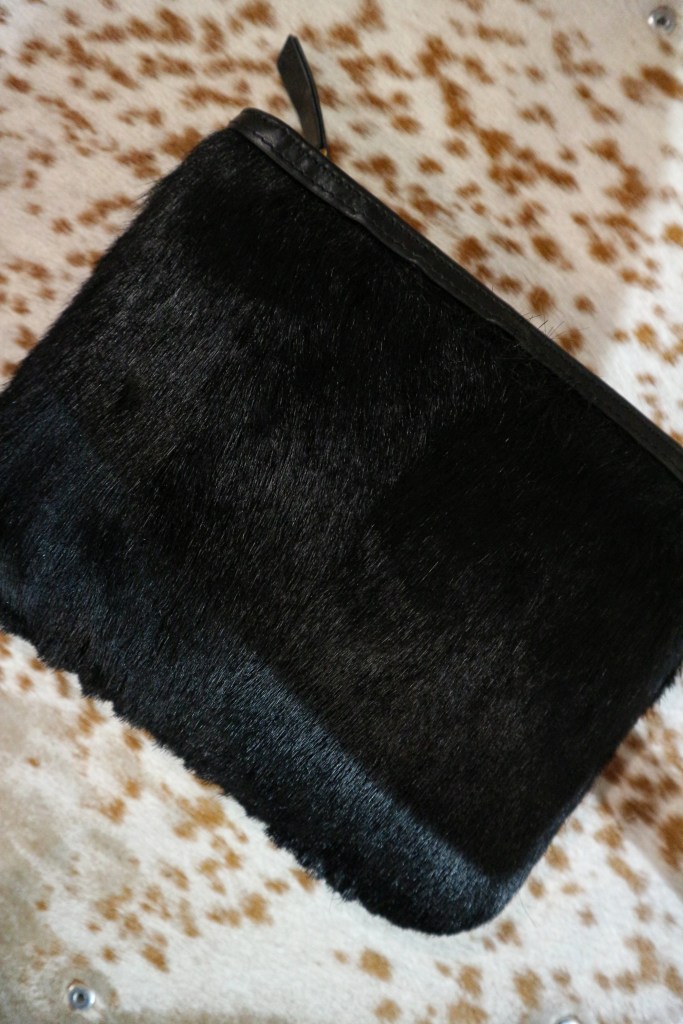
C: My first investment piece was an Okapi pouch that I bought when I had just started working at Merchants on Long. I saw this black, Springbok fur pouch, and I just thought it was the most beautiful thing I had ever seen. I knew I had to have it. That was my first investment piece, because, at the time, it was pretty pricey and I was thinking to myself, “Chandra, you just graduated, where are you going to go with this pouch? You are not in that scene yet where you can just carry around this Springbok pouch.” But, I convinced myself that I needed this pouch!
S: Have you had a lot of wear out of it?
C: Yes, now I have. At fashion week, I made a point of carrying it around, because I needed the world to know that I had this pouch and that it was amazing. *laughs* And actually, it really was an investment, because they don’t sell it anymore. So, it’s one of those pieces that I am holding onto. I think they started moving away from Springbok fur, because people were having a problem with fur in general and people were not understanding that some fur is a by-product and others are more unethical. That is why I don’t have a problem with vintage fur, but if it is fur just for the sake of fur then that is not great.
M & S: What do you think is the biggest opportunity for the African fashion industry, going forward?
C: The biggest opportunity is that we can learn from the mistakes of the rest of the fashion industry, knowing that we don’t have to replicate them here. I don’t think that just because other fashion industries rely on mass production that we should do the same thing. I think we have the opportunity to do things in smaller collections (like made-to-order), bring back the age of tailoring, create one-of-a-kind pieces and incorporate repurposed deadstock. So many African designers have already incorporated so much about sustainability into their brands, so we can lead this movement and start shouting louder than the West – WE ARE THE LEADERS IN SUSTAINABILITY, NOT YOU! The best way to do that is to get more people to support local and invest in local.
M: I would agree. In terms of supporting local and people choosing fast fashion brands, how do you think that local designers can create clothing that can bridge the gap between the people who can afford fast fashion, and the people that can already afford local designers?
C: I would say diffusion lines, or how we have seen some brands collaborating with H&M. So, you can have a designer piece, but it is more accessible price-wise. It would be great to see local brands collaborating with Mr Price or Woolworths.
Or, they could just create their own diffusion lines (like, Extra Curricular by Thebe Magugu) where items are substantially cheaper and people won’t feel so excluded or up in arms about how expensive garments are. I swear, every time Maxhosa or Rich Mnisi release new collections, people are like, “this sweater is R2000?!” I understand that that is a lot of money, and there are a lot of people who cannot afford that, because they have more urgent expenses. But I think people need to decide on their definition of luxury, and designers need to meet people halfway.
That’s why I think diffusion lines, or collaborating with Mr Price on small, capsule collections is a great way for people to learn more about local designers, because, right now, the prices just make them so inaccessible and people won’t even bother walking into a store that they know they can’t afford.
S: Can you explain what a diffusion line is? I don’t think I have heard the term before.
C: A diffusion line is when a brand makes a cheaper or more accessible version of their main brand. So, you get ‘Michael by Michael Kors’ where the ‘Michael Kors collection’ is the luxury brand and then he has ‘Michael by Michael Kors’, which is more accessible. It’s a great way to introduce customers to your main brand, without them feeling like they have to spend a tonne of money.
M: It’s also a way of building loyal customers. It has worked well for brands, in terms of accessing a younger market. For example, perfumes have been one of the things that have been an entry point.
I think if they collaborate with H&M and that kind of brand, it becomes an ethical issue, because H&M does not have ethical value chains, and the reason why it is cheaper is because they are using H&M’s production. The designer just designs the clothes, and then H&M does the rest.
S: Yes, and then people start doubting the integrity of the brand as well.
M: Exactly. There was a tonne of slow fashion type designers who recently collaborated with H&M and people were like, “what the fuck?”
C: I know! I saw Lem Lem! I first saw Lem Lem at Merchants on Long, and it is the most beautiful, luxury, ethically made resort, and summer wear. Their values just don’t align with H&M, but I also understand that this is one of the best ways to introduce people to your brand, because they don’t have the same marketing budget, and global reach, as H&M. So, business-wise it makes sense, and I hope that in the long term, more customers will buy directly from them. But, I was also very surprised, because it was a collaboration that I never saw coming. I understand, but I don’t understand.
M: Then it’s this thing of the small brand playing into this idea that H&M has created for themselves as being ethical and sustainable, because why else would you partner with them? I agree that it is a great entry point, but it is almost the same as those greenwashing conscious collections that H&M does.
C: For sure. So, it becomes a question of: do you sell your soul in the short-term, so that you can have long-term success?
S: And, will you have long-term success? Will people still follow the brand back to its roots after the collaboration?
C: True. Lem Lem is expensive, so now people can get this Lem Lem piece for $50 and then they go on the Lem Lem website and realise it would probably cost $300 for a similar piece. So, maybe that will cause people to want to just stick to H&M.
M: Yeah, does it result in people thinking that the original brand’s price is worth every penny? Or, are the brands just showing people that there is a way of creating your garments for a lot cheaper, and then people will start questioning how this is possible – is the original brand’s price a huge markup for profit? This is not the case, but it can start to look like that.
I like the idea of having more affordable and accessible lines, with Mr Price, but it should be more of a basics line. And, more basics in terms of sewing, so that people don’t find it unbelievable that it could be produced cheaper.
M & S: You also started a series where you review retail spaces. What inspired you to start this series, and what do you hope people will take away from it?
C: I started that series, because I thought Merchants on Long was the only place to find African fashion. It was a consequence of the fact that I worked there and so I was buying a lot from them. But, Merchants stocks such expensive things, so I started thinking that there must be other places where I can get local design. I remember going to a Lukhanyo Mdingi event at AKJP and that’s when I discovered the store for the first time. AKJP is a really cool store! I was blown away and there were a lot of other designers that I was introduced to. That just prompted me to look for more places and I discovered that there are a lot, in Cape Town. So, I thought I should share these places, because I was discovering places that were cheaper and more accessible, but the quality was still tops.
Of course, a lot of the places I share are places I would buy from, because I would never recommend a place that I would never buy from. But, I think that because I was introduced to luxury African fashion, through Merchants, my standards are ridiculously high now. I scrutinise things a lot, and I spend a lot of time researching what I consider to be the best item. This is not necessarily linked to price, but for example, if I need pyjamas or sweatpants, I’ll spend a lot of time researching what I think the best brand is. This is where wish lists come in handy, again.
M: I love your reviews, because I would never have thought of going into a Louis Vuitton store since I don’t have the money. But, through this series, you showed me that you go into places, even when you know you are not going to buy anything, just because you like to look. That made me realise that I can do that too.
C: Definitely! I encourage everyone not to feel afraid to go into these stores, no matter how intimidating the sales staff are [or can be]. Go in and try on the clothes and bags! It also helps you to see what works for you, and what is out there. Most importantly, it helps you define what luxury really means to you.
M: If you like making wish lists then it helps to try the things on so that you know how it looks on you, especially if you are saving up a lot of money to invest in a piece.
C: Exactly. I always go in and say that I’m here to try things on, and then I do come back if I find something that I like. It’s just so important to make sure you experience something before you buy it, because impulse buys are always the ones you will regret.
M & S: What is your favourite item in your wardrobe, and why?
C: My favourite items in my wardrobe are – without a doubt – all my MaXhosa pieces, especially my jacket from the Autumn/Winter 2014 collection. It was gifted to me after I did everything I could to own it before the entire collection sold out in-store! It was the beginning of my obsession with the brand.

M & S: What is your favourite cost-free place to go in your city?
C: Nothing original but I have to say the beach! It’s a great place to destress. There’s no better feeling than sitting on the sand, with a notebook for any important thoughts that may pop up while watching the sun go down. Llandundo and Camps Bay are my favourite.
M & S: Where do you go when you want to treat yourself?
C: I used to love going to restaurants because there are so many amazing places in Cape Town (I’m a total food snob now! #helpme) but this year, my focus has been on improving my health and overall appearance, so now I treat myself to spa treatments, sessions with a chiropractor, skincare, and most importantly, therapy.
M & S: What social media account is inspiring you right now?
C: Kelly Stamps (@thekellystamps)! I absolutely love her. Her Youtube channel is a constant source of inspiration and escapism. Her honesty, self-deprecating humour, and pursuit to live her best, care-free life is what keeps me hooked. She’s basically the perfect representation of the life I would like to live – frugal yet bougie. I also love that she’s into kpop! I’ve been a kpop fan for almost 10 years so seeing it being appreciated globally has been awesome (except for the cultural appropriation but that’s a topic for another day!).
M & S: What is on your local brand wish list?
C: How much time do you have? LOL At the top of my list is the MaXhosa A/W14 waterfall cardigan, a Thalia Strates handbag, Thebe Magugu envelope pouch, Apartment perfume, and jewellery from Coast The Label.

MaXhosa A/W14 waterfall cardigan 
Earrings from Coast The Label 
Thebe Magugu envelope pouch 
Apartment perfume 
Thalia Strates handbag
We highly recommend giving Chandra a follow on her Instagram, and if you want to find out more about her journey with slow and African fashion, you can give her blog a read too!
With love,
Masego and Stella
 cnscs_